What is Good Posture?
- Jul 30, 2024
- 4 min read
Updated: Jan 22
Good posture improves how you look and feel, but if you’ve tried to improve your posture you know how impossible it seems. You sit up straight and squeeze your shoulders back, but a moment later you’re slouching again. The reason is because most people focus on the wrong thing.
Try this yourself. Place one hand on your low back and the other at the back of your neck and then round forward. You’ll feel these muscles activate. Now, lean back until you feel these muscles relax. Repeat this to feel how active your muscles are when your bones are not balanced.
Most people think good posture requires muscular effort, but that’s not true. Better posture requires the least amount of force to maintain. Good posture is balance, not force. Better posture balances bones, while worse posture uses muscles and ligaments to hold you up.

Every time you sit at your desk, lean over your laptop, or lie on the couch, you’re habitually loading your tissues in one direction. This repetitive poor posture can wear down our tissues and lead to chronic pain. Identify if habitual loading patterns cause you pain:
Flexion intolerance is when rounding forward creates pain.
Extension intolerance is when arching back creates pain.


Breathing Posture
The most difficult part of maintaining good posture is awareness, and our breath is our path to awareness. Breathe deeply with your diaphragm as this will help keep you aware of your body and your spine aligned.
The primary breathing muscles are the diaphragm at the bottom of your lungs and the intercostal muscles between your ribs. Visualize and feel your diaphragm pressing down into your abdomen and your ribs expanding laterally on each breath. Read more about breathing here.

Better Posture in 2 Steps
Posture is how you hold your body against gravity. Here is how to do this with good posture.
Step 1: Neutral Spine
With a neutral spine, you won’t feel spine bumps as when rounding, or a deep spinal groove as when arching.


Keep your nose below your ears so your head is balanced on your shoulders.

The feet are the foundation of your spine when standing. Spread the toes as much as possible and place your weight into the outer part of your foot and the toe pads and avoid heavily loading the heel.

Keep your feet straight, narrow, and under your hips.


Externally rotate your knees as if you were to wrap your legs around you to align your hips, knees, and ankles.

Keep the knees and hips soft. Place your fingers where the legs meet the hips and gently push back to place your hips slightly behind you.

Ancient statues depict humans as back chain dominant - and it's how babies walk before we corrupt them.

When sitting, the foundation of your spine is your hips. Roll the hips forward to balance a neutral spine.

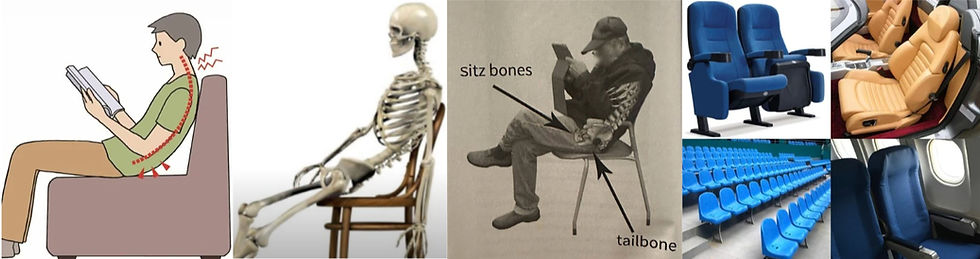
Sit on your hands and feel for the two hip bones under your hips - these are your sit bones and this is where your weight should be placed when sitting, not your tailbone or pelvic floor.


Elevating your hips makes it easier to roll your hips forward. Sit on a wedge or tuck one or both legs under so that your knees are slightly below your hips and you’re able to easily roll your hips forward to maintain a neutral spine.


Sit like a happy dog wagging their tail - don’t sit on your tail!


Let your legs open and spread your butt cheeks to widen your base of support.


If you position your feet well when standing and hips when sitting, the spine easily balances and everything else tends to also balance. However, some people also benefit from thinking about externally rotating the shoulders. Reach back with one arm at a time like you’re trying to reach for something in the backseat of a car and then ‘anti-shrug’ your shoulders down to set your shoulder blades onto your rib cage.


Step 2: Be Tall
Once you've found a neutral position when standing or sitting, attempt to lengthen your spine as if you’re trying to get as much space between your hips and the top of your head.

Conclusion
Today most seats are designed to make you slouch and most people slouch. If most of your family and friends sit with poor posture, that becomes normal to you. If this habit is left unchecked, it can cause long term back pain like it did for me.
The most common posture mistakes are overcorrections. For example, most people have become terrified of “anterior pelvic tilt” so they push their hips forward and squeeze their butts, but this actually worsens their pain. Other people believe that keeping their “chest up” is needed for good posture, but they overarch their low backs and worsen their pain. Don't force change, position yourself well and good posture is easier.
Consider getting these posture books to learn more about posture and your body and if you just can’t seem to improve your posture, consider scheduling a fitness consultation to work with me directly.
If you have questions, send me a message or comment below. Hope this helps! - Tom

Comments